Start with the whole object
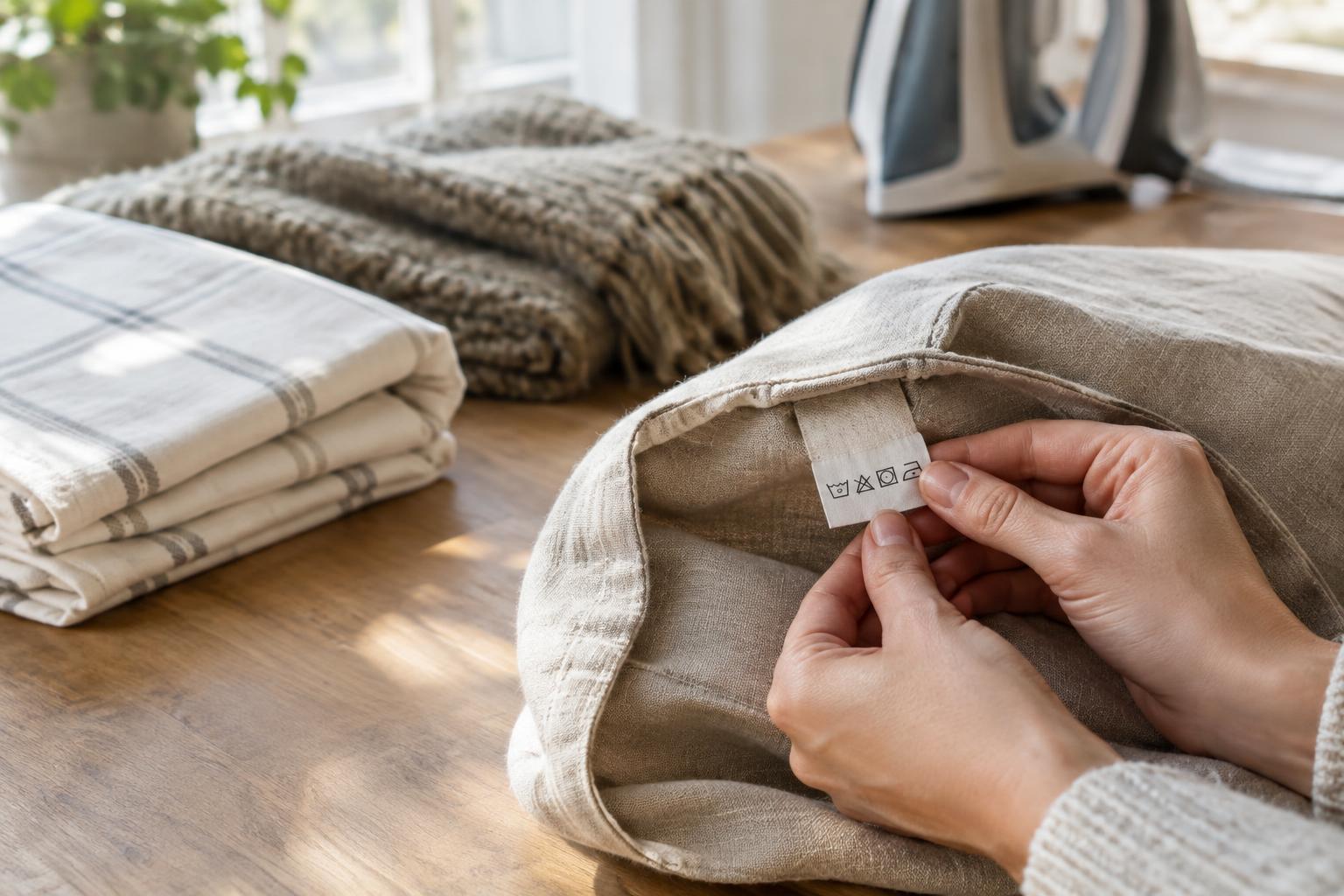
Care labels are easy to overlook until a favorite cushion cover shrinks or a table runner comes out of the wash with puckered trim. Before cleaning a household textile, find its sewn-in or attached label and read all the instructions, not just the fiber content. A label may tell you what the fabric is made from, where it was made and how the finished item should be cared for. The care instructions are the part to follow when choosing a cleaning method.
Consider every component of the object. A cotton cover may also have a zipper, lining, embroidery or decorative edging. A washable outer fabric does not necessarily mean an insert or filling can go in the machine. If the cover is removable, check the cover and insert separately. For a quilted mat or lined curtain, the least wash-tolerant component may determine the safest approach.
Decode the basic symbol shapes
Many care labels use a small set of shapes. A tub of water refers to washing, a triangle to bleach, a square to drying, an iron to pressing and a circle to professional cleaning. A cross through a symbol means not to use that method. Lines and dots add conditions: a line beneath a wash tub usually calls for a gentler cycle, while dots commonly indicate a temperature setting. Because labels can also include written instructions, read the words alongside the symbols.
Inside a wash tub, a number may give the maximum water temperature in degrees Celsius; dots may instead indicate a temperature range. Treat the stated temperature as a limit, not a target. Cooler water may be suitable for many everyday loads, provided it cleans the item adequately. If the tub is crossed out, do not machine- or hand-wash the item simply because its fiber sounds washable. A hand in the tub calls for hand washing, with gentle handling rather than vigorous scrubbing.
The triangle concerns bleach. An empty triangle generally permits bleaching, while a crossed-out triangle means avoid it. A triangle marked with diagonal lines indicates that only non-chlorine bleach is permitted. When in doubt, skipping bleach is often the simpler choice, particularly for colored fabric, embroidery and contrasting trims.
Read drying and ironing instructions carefully
A square with a circle inside represents tumble drying. Dots in the circle indicate heat level, and a crossed-out version means do not tumble dry. Other square symbols describe ways to air-dry, such as hanging or drying flat. These distinctions matter for throws, knit cushion covers and loosely woven pieces that may stretch under their own weight when wet. If the label says to dry flat, support the item in its intended shape on a suitable drying surface.
The iron symbol gives pressing guidance. More dots usually allow more heat; a crossed-out iron means do not iron. A crossed-out steam mark beneath an iron means press without steam. Begin with a lower setting if you are unsure, especially on synthetic blends or decorative surfaces. Press embroidery, pile fabrics and textured weaves from the reverse side when appropriate, using a clean pressing cloth to help protect the visible face. Avoid pressing directly over beads, plastic trims or raised embellishments.
Understand professional-cleaning marks
A circle on its own refers to professional cleaning, not an ordinary spin in a washing machine. Letters inside the circle provide instructions for the cleaner about suitable processes. A crossed-out circle means do not use that professional-cleaning method. Some labels also spell out “dry clean only” or give a professional wet-cleaning instruction. If the symbols are unfamiliar, show the complete label to the cleaner rather than guessing from the fabric name.
This is especially useful for structured household items, such as lined curtains or tailored slipcovers. Even when the face fabric could tolerate water, linings, interfacings and seams may respond differently. Cleaning panels from the same room together may also help them retain a more consistent appearance, although their labels should still be checked individually.
When the label is missing or unclear
A missing label calls for a cautious approach. Look at the construction first: is the item lined, loosely woven, dyed in several contrasting colors or finished with glued-on decoration? Remove loose dust with a soft brush or vacuum attachment where appropriate. For a small mark, test any cleaning method on an inconspicuous area and let it dry fully before treating a visible spot. Do not assume that a successful spot test proves the entire piece can be soaked or machine-washed.
Keep a simple record for textiles you clean regularly. A note on your phone or a tag stored with spare linens can identify the item, its fiber content and the care instructions if the original label fades. Reading the complete label before the first wash takes only a moment and makes later care decisions much easier.