Texture starts with the yarn
Two woven throws can use the same fiber and weave pattern yet feel quite different. Yarn thickness affects how much space each strand occupies; twist affects how tightly its fibers are held together. Both change the way yarns meet in the cloth, whether they settle into a soft surface or retain a crisp outline. Fiber type, weave structure, yarn spacing and finishing matter too, so treat thickness and twist as useful starting points rather than guarantees.
Before choosing yarn, decide what you want the throw to do. A piece for curling up on a sofa may benefit from softness and easy drape. One intended to add texture at the end of a bed might call for a more visible weave or a substantial edge. Holding a yarn in your hand offers clues, but a woven and washed sample is a better guide to how it will behave in the finished throw.
What thickness changes
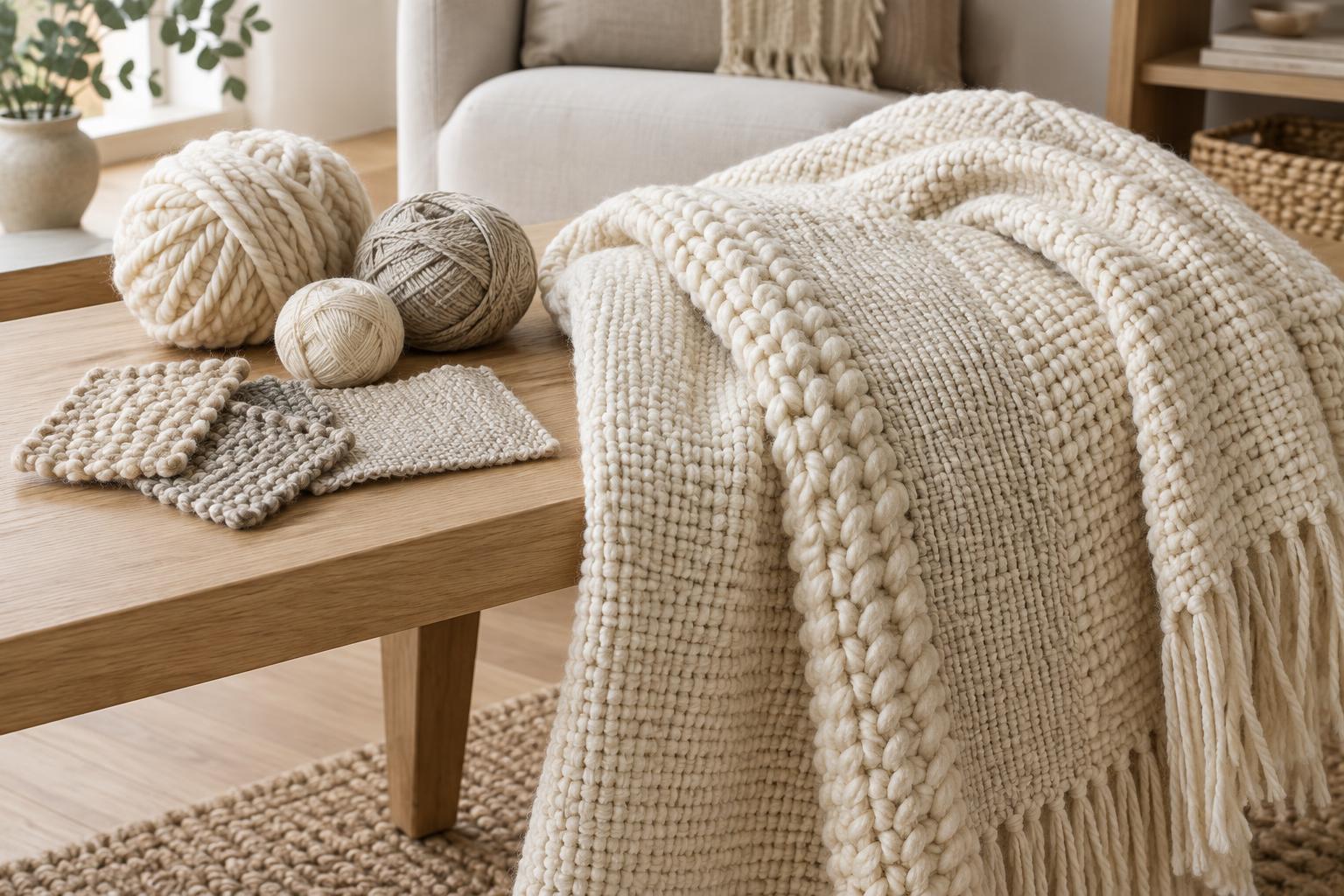
Thicker yarns tend to make a weave’s individual lines more visible. Used in the weft, they can create pronounced ridges, especially when set against a finer warp. They also build fabric quickly, though the result is not automatically warmer or heavier: the spaces between yarns and the fiber used still matter. A thick, airy yarn may feel very different from a dense yarn of similar diameter.
Finer yarns allow for more intersections in a given area and can produce a smoother-looking surface. Depending on the weave and spacing, the cloth may feel fluid rather than bulky. Mixing thicknesses is another option: alternating a smooth, fine weft with occasional thicker picks gives a throw restrained bands of texture. Keep the contrast moderate for a piece that needs to fold comfortably; a very bulky accent yarn can make some areas stiffer than others.
How twist shapes the surface
Twist helps yarn hold together. A firmly twisted yarn often looks more defined and may better reveal a weave pattern because it is less inclined to spread at each crossing. It can also feel comparatively firm. A loosely twisted yarn may bloom into neighboring spaces, giving the cloth a softer, hazier surface. The effect depends on the fiber and construction: a soft fiber does not necessarily become harsh when twisted, and a low-twist yarn does not always make a supple fabric.
Twist also affects handling while you weave. Low-twist yarns may shed or abrade when repeatedly rubbed, which is particularly relevant for warp threads under tension. Firmly twisted yarns are often easier to use as warp, while a softer, less tightly twisted yarn may work well as weft. This is a practical tendency, not a fixed rule. If a yarn snags or pulls apart in a short sample, reconsider where you use it before committing to a full throw.
Balance yarn with weave and spacing
Yarns need room to interact. When they are packed closely, even soft, lofty yarn can make a dense fabric with limited drape. With more space, the same yarn may open up and show its character, though too much space can leave the cloth unstable. The right spacing depends on yarn diameter, weave structure and the intended use of the throw. A balanced plain weave gives an approachable place to test these relationships before trying more elaborate patterns.
Pay attention to what happens where warp and weft cross. A thick weft may dominate the surface if the warp is fine or widely spaced; a thick warp may remain prominent through the finished cloth. Neither is wrong. Choose deliberately according to which yarn’s color and texture you want to see. If you plan to add fringe, remember that its feel will also reflect the warp yarn’s thickness and twist.
Make a sample you can live with
Weave a sample large enough to show several repeats of any texture or stripe you have planned. Record the yarns, weave and spacing so you can reproduce what works. Off the loom, compare its appearance and drape with what you expected. Then finish it using care appropriate to the fiber and compare again: washing and drying can change the gaps between threads and the prominence of surface texture.
Handle the dry sample as you would the throw. Fold it, lay it over a chair and feel both sides against your skin. If it seems too rigid, consider a finer or softer weft, a different spacing, or a less compact weave. If it lacks definition, try a more firmly twisted yarn or adjust the yarn balance. Changing one element at a time makes the result easier to understand—and brings you closer to a throw whose texture suits both the room and the way you use it.