What boxed corners do
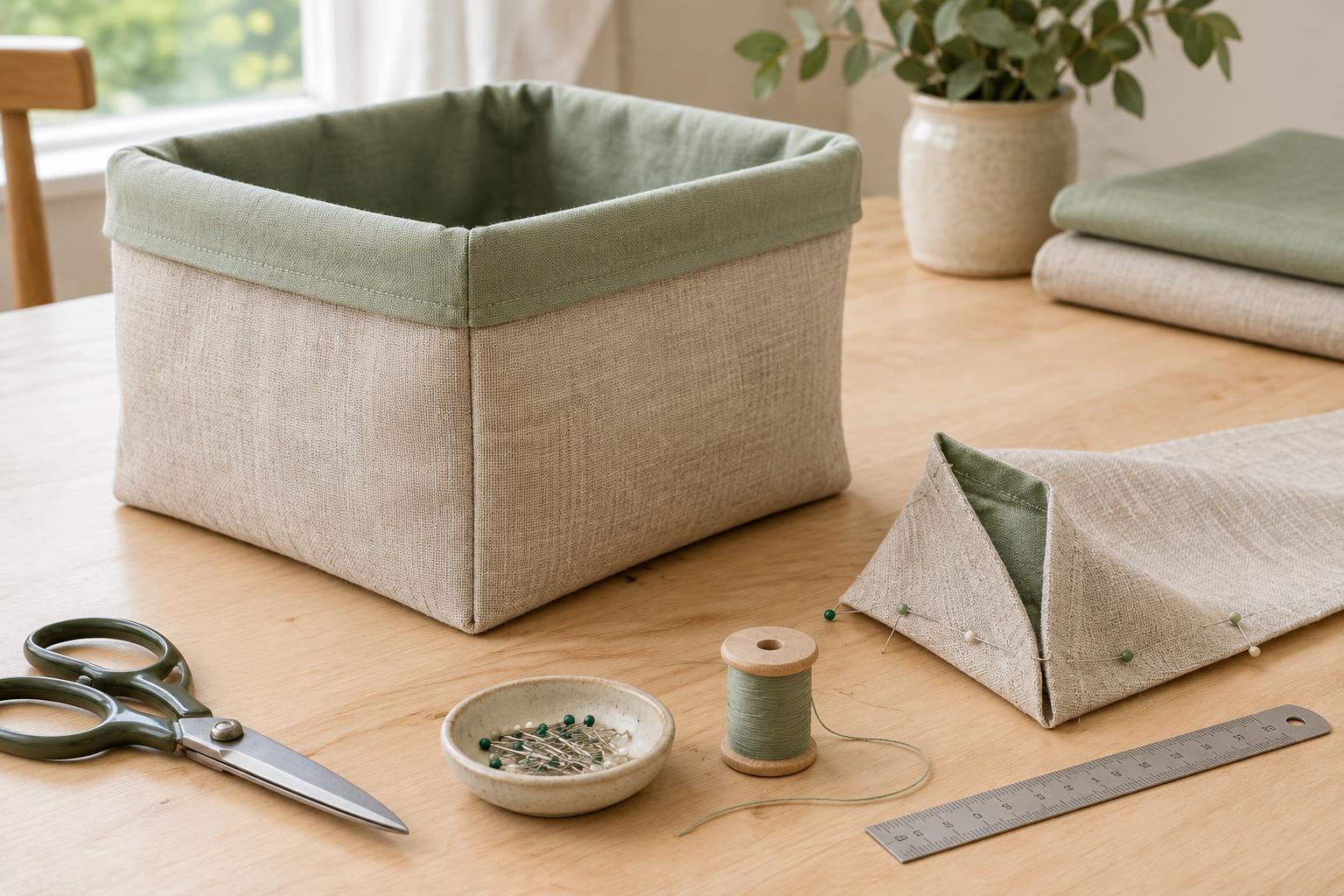
A boxed corner changes the point where a side seam meets a bottom seam into a short seam across a triangle of fabric. Repeat this at both bottom corners and a flat bag gains a rectangular base. It is a useful technique for a small basket that can hold folded cloths, craft supplies or other lightweight items on a shelf.
The width of the line sewn across each triangle determines the approximate front-to-back depth of the finished base. A wider line makes a deeper basket, but also takes width and height from the flat panels. Before cutting a treasured fabric, try the technique on scrap cloth or paper to get a feel for the proportions.
Choose fabric and prepare the panels
For a first basket, use a firm woven cotton or canvas for the outside and a lighter woven cotton for the lining. Very soft fabric may slump, while thick fabric can make the corners bulky. Fusible interfacing can help the outer panels hold their shape; choose a weight that suits the fabric and apply it according to its instructions. Keep in mind that this sewn basket is intended for light storage, not as a rigid container.
Cut two matching rectangles for the outside and two for the lining. For a sample basket, cut all four pieces 14 inches wide by 12 inches tall. Use a 1/2-inch seam allowance throughout and plan to sew a 4-inch-wide line across each corner triangle. Mark the top edge of every panel so that a print or directional weave stays upright. If you are adding interfacing, attach it before assembling the basket.
Sew and mark the outer corners
Place the outer panels right sides together. Sew down one side, across the bottom and up the other side, leaving the top open. Press the seams where you can. At one bottom corner, open the layers and flatten the corner into a triangle, bringing the side seam directly over the bottom seam. The seams should meet at the triangle’s point and run along its centre. Pin through both seam lines to keep them aligned.
Measure across the triangle, perpendicular to the aligned seams, until the line is 4 inches long from one folded edge to the other. Mark that line and stitch along it. Check that the fabric is smooth and that the side and bottom seams still meet before sewing the second corner in the same way. Trim the fabric beyond each new seam to about 1/2 inch, or leave it untrimmed until you have checked the shape. Turn the outer basket right side out and gently push out the new base corners.
Add a lining with matching corners
Sew the lining panels right sides together along the sides and bottom, but leave a hand-sized opening partway along one side seam for turning. Box its bottom corners exactly as you did the outer corners, using a 4-inch line on each. Matching measurements matter: if the lining corners are much narrower or wider, the lining may pull at the base or bunch inside.
Leave the lining wrong side out and the outer basket right side out. Slip the outer basket inside the lining so their right sides face each other. Match the side seams and raw top edges, pin around the opening, then sew around the top with the same 1/2-inch seam allowance. Pull the basket through the gap in the lining. Close the gap with a small machine seam near the folded edges or with hand stitches, then tuck the lining inside. Press the top edge and, if you like, topstitch around it to help keep the lining in place.
Adjust the fit and finish
A boxed corner changes the basket’s proportions as well as its shape. With the same panel size, a deeper box produces a narrower base and a shorter finished side. For a wider base, start with wider panels; for taller sides, start with taller panels. Make every corner line the same width and measure it from folded edge to folded edge rather than from the triangle’s point.
If a finished basket leans, check whether both boxed seams are equal and whether the lining sits fully down in the base. Pressing and gently shaping the corners often helps. A basket for display can be left plain to show the fabric, or finished with a narrow topstitch for a crisp rim. Once the basic shape makes sense, the same corner technique works for simple fabric bins in a range of sizes.